Showing posts with label Dorset. Show all posts

Saturday, April 16, 2011

St Andrew, Minterne Magna, Dorset

Heading back to Sherborne we approached this quirky looking church by the road with a car park opposite for the Minterne Gardens visitors. As soon as Marion saw the tower which dates from c1800, she remembered the church and commented that there were good monuments inside. Sadly it was now ten past six and the church was locked. One to earmark for another day.
We arrived back at the hotel where I met George (Mr Marion) and joined them both for an *evening meal / supper / dinner / tea (*delete as necessary - it was one of the many threads of conversation we had over the next two hours). All in all a good day out, with pleasant company and lovely looking weather albeit a little chilly in the wind. Add to that a listen to this years Eurovision Song Contest entries (all 42 of them) on the drive down and drive home and it was near perfect. I did offer to let Marion hear them too but she politely declined.

St Mary, Cerne Abbas. Dorset

This was long an objective for the day but with all the stops we kept doing it was gone 5pm when we got here.
The church sits proud above the small town square, at the end of Abbey Street. The abbey has largely disappeared. Mostly Perp, although the chancel has some EE features in the side lancets, but the large east window of six lights is Perp. It wouldn't have been seen from the nave originally as the stone screen, with its solid wall where one might expect a dado and pierced openings above, originally had solid wall above it too. The church has been well restored and also there is a good touristic display and guide. The interior is wide and spacious. In the sanctuary are remains of wall paintings but there are no real memorials of note, and only Jacobean rails and a pulpit with tester (which for some reason I cut off in the photo I took - duh!). Texts survive aplenty,one with date 1679 (north side of nave) and another of 1962 (south side of nave) although I suspect this refers to the restoration of them throughout the church.
Soon too we were greeting a naked old man who was well pleased to see us as we munched a late picnic of Eccles Cakes in the picnic area to the north off the little town.

All Saints, Nether Cerne, Dorset


A CCT church, sited away from the road seemingly on the front lawn of a house. I eventually plucked up courage and drove down a farm track to reach it. I wonder today if the CCT would accept this ine, as there is very little to note about it apart from its picturesque situation. West tower nave south transept and chancel with a norman tub font.

Holy Trinity, Godmanstone, Dorset

Sharp braking as we spotted a sign saying "<11th Cent. Church". We parked opposite England's smallest pub which caused me some consternation as I had been here before and had a drink but could not remember when or where I had been travelling to. I certainly had not been to the church before.
Not large and entered via a suspicious looking Norman south door, where even the two doors were "Norman"; the interior of the same doorway had a definite C19 arch. However the chancel arch is definitely original. Not a great deal else to see, some early Victorian tablets in the chancel.

St Mary, Charminster, Dorset

At a quick glance the exterior looks all Perp, with a handsome tower with sixteen pinnacles, three grouped together at each corner of the parapet. However looking closely a Norman clerestory is evident. Inside Norman arcades, fat circular columns but with pointed arches. Marion hugged a pillar - she loves Norman apparently ;-) I used the font as a brace for the camera as is evident in the photo! Two purbeck canopied tombs in the south aisle, one with the indent of a lost brass, and also a coloured kneeler monument to Grace Pole d1636. There is also a good Jacobean pulpit. The chancel is surprisingly short and bare and dates from c1838; the east window however is a reset C17 original with unusual tracery

St Mary, Puddletown, Dorset

This church was one of my planned objectives for the day, and the furthest away that we travelled from Sherborne before turning back. The church is remarkable for preserving its pre-Victorian interior in large part. There is a west gallery dated 1635, high box pews, a three decker pulpit, font cover and three-sided communion rails. The monuments that must have been originally elsewhere are all crammed into the south transept and are in a poor state of repair. One alabaster tomb chest poorly reassembled with two effigies and two of its sides now placed on the walls behind. Another older pair of effigies have been placed under another canopied tomb, and the lady's lower half cut out to fit around the support; her fella is black with damp mould. All of this must have been done a long time ago, it is not recent "vandalism" and to be fair in the chapel is a discussion document about planned conservation and restoration of these monuments. The chancel and north chapel are Edwardian 1910-11 by Ponting, but a good match. I wondered what was here before - and the date of construction must mean old photographs survive. Under the gallery hang some odd fire buckets, and the font cover also of c1635 sits on a remarkable Norman tub font.
On entering the church got the WOW I expected from Marion, but closely followed by an OH! From outide Marion had no idea that she had visited before but seeing the font and the fire buckets she realised she had. This was my first visit to every one of the churches seen on our day out. However Marion was not disappointed to come here a second time.

Piddlehinton - The Waterloo Nurse memorial

Supplemental picture of the grave Marion looked for but I found ;-)

St Mary, Piddlehinton, Dorset

Suitably refreshed with a sandwich and a taster of St Austell Tribute (yum! - although Marion needed her lemon and lime to cool down her mouth after a fiery mustard was liberally spread in her sandwich!) the onward flow of the Piddle took us to Piddlehinton.
The tower is bulky and sits unusually in the south transeptal position. It obviously echoes its fancier neighbour to the north, but sqatter and with less pinnacles (only seven). Marion, intrigued by a notice in the porch set off to see the grave of a nurse who served at the Battle of Waterloo and received a pension from the army. Nowhere as famous as Florence Nightingale and you wonder why. However Marion used her own sense of direction and hunted high and low on the wrong side of the church, bless.
Inside not a great deal to see but another handsome spacious church although the south side is more irregular because of the tower. The chancel has a plaster vault recalling Trent church north of Sherborne, although it seems the vault here is earlier so maybe inspiring rather than recalling. Apologies for the poor picture of the brass to Boy George in the chancel. It is him surely?

All Saints, Piddletrenthide, Dorset

From Alton Pancras we followed a steady ever-widening stream of Piddle (sorry, couldn't resist it) and arrived at the stunningly pretty village centre around the equally handsome church at Piddletrenthide but still not having seen a pub (but reassured by the lady at Alton Priors that this next village had not one but three pubs to satisfy us!)
The tower bristles with 16 pinnacles, and has many carved beasts and gargoyles placed high up making appreciation of them a little difficult. Easier to appreciate the little animals on the set-offs of the buttresses almost at head height. All seemingly Perp, but entering the porch there is a Norman doorway of unusual design, and then the chancel arch responds are also Norman although well disguised. After all the show outside, the interior was a tad disappointing with Victorian roofs and nothing much of note apart from a large number of sentimental Georgian tablets with distraught women, and one early C18 cartouche; its neighbour mentioned in Pevsner seems to have been removed leaving an outline and a small skull embedded in the wall which supported it (both flank the tower arch).

St Pancras, Alton Pancras, Dorset

No pub to be seen in Buckland Newton and none here either...... but another church!
Probably the dullest church of the day, but the cleanest. We met an awfully nice lady who hurrumphed that we were most welcome and lucky too as they had just finished the church's spring clean! The smell of polish was in the air when we entered. Medieval west tower, the rest a produt unusually of two different architects, Ewan Christian did the chancel, and the local Crickmay did the nave. Perp font, looking recut too. However not mentioned in Pevsner is the norman work over the the north door, not something that Crickmay would have invented.

Church of the Holy Rood, Buckland Newton, Dorset

As we approached this church we both felt the first pangs of hunger and decided to descend on the first pub we saw for a spot of lunch.
The exterior is rendered, most unusual for these parts. Also unusual is that the south face of the tower has no bell openings. The panelled chancel arch and nearly everything to the west is Perp, light and spacious with large three light transomed windows. The chancel however is EE with side lancets (embellished inside with tall purbeck marble shafting) which cause T H Wyatt to put in a stepped triplet to match for the east window. The church was open but the PCC must also be worried about theft. The tower screen and door had several notices about dire consequences of entering - THE CODE HAS BEEN CHANGED - IF YOU DO NOT KNOW THE NEW CODE DO NOT ENTER". As we did not have the old code either, we didn't! Not satisfied with that, there is also a monster sign from a Security Company, of the like seen on Building Sites. We looked around, enjoying the ancient seated figure over the door (St Thomas according to the signage, yet looking uncomfortably like a Sheil-na-gig too), an ancient poor box, and the vaulting of the porch. We did not touch the lectern either, and normally I would not have photographed it either, but have a look!

Friday, April 15, 2011

St Mary, Glanvilles Wootton, Dorset

I amused Marion by my rather inept attempt to turn and park the car at the end of the lane that leads to the church. It was not until we came out the porch that we noticed a car park oppoisite the church gate!
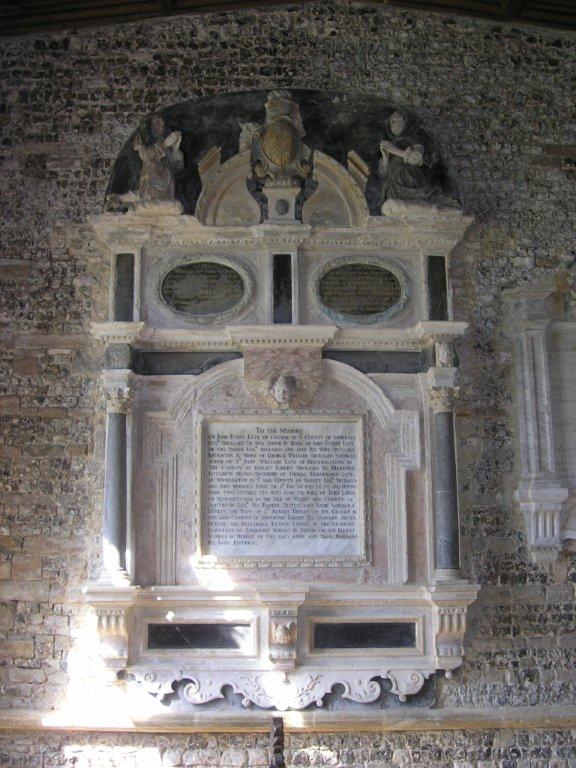
West tower, nave and chancel, with notable south chapel off the nave. Much restored and partly rebuilt. Two recesses in the south wall of the chapel below the fine windows, one with an alabaster effigy of a Civilian, his face retooled and resembling a Victorian gent rather than a medieval one. On the chapel west wall a hanging monument of 1679 to John Every of Cothay House in Somerset, mainly epitaph but with two entertaining kneeling figures on the top flanking a pediment.